Designy Digest / 002
There's a tool for easily detecting AI generated content, the old design process is no longer valuable, and you really should never say you’re sorry (in design).


The Daily Sprint, Episode 6
Give it a listen and find out whether design is dead. Spoiler alert: you know...
 Darrell Estabrook
Something’s up on LinkedIn
This week, I noticed something odd about certain LinkedIn posts. I suspected they were written by AI, but now I know. How?
I stumbled upon a service called GPTZero.
When you analyze text, it creates a report with the percentage chance the text was written by AI. The web app goes into extreme detail and lets you investigate sentence by sentence and why it was classified as human or AI.
There's a Chrome link which makes scanning LinkedIn posts, or any webpage content, very easy.
GPTZero assessed this LinkedIn post with a 100% chance of being AI-generated. It sounds great, but by definition it’s not an original thought from the author. That is, even if we assume this was content based only on a library of the author’s own work, the output is contrived in such a way as to be detectable as being AI-generated.
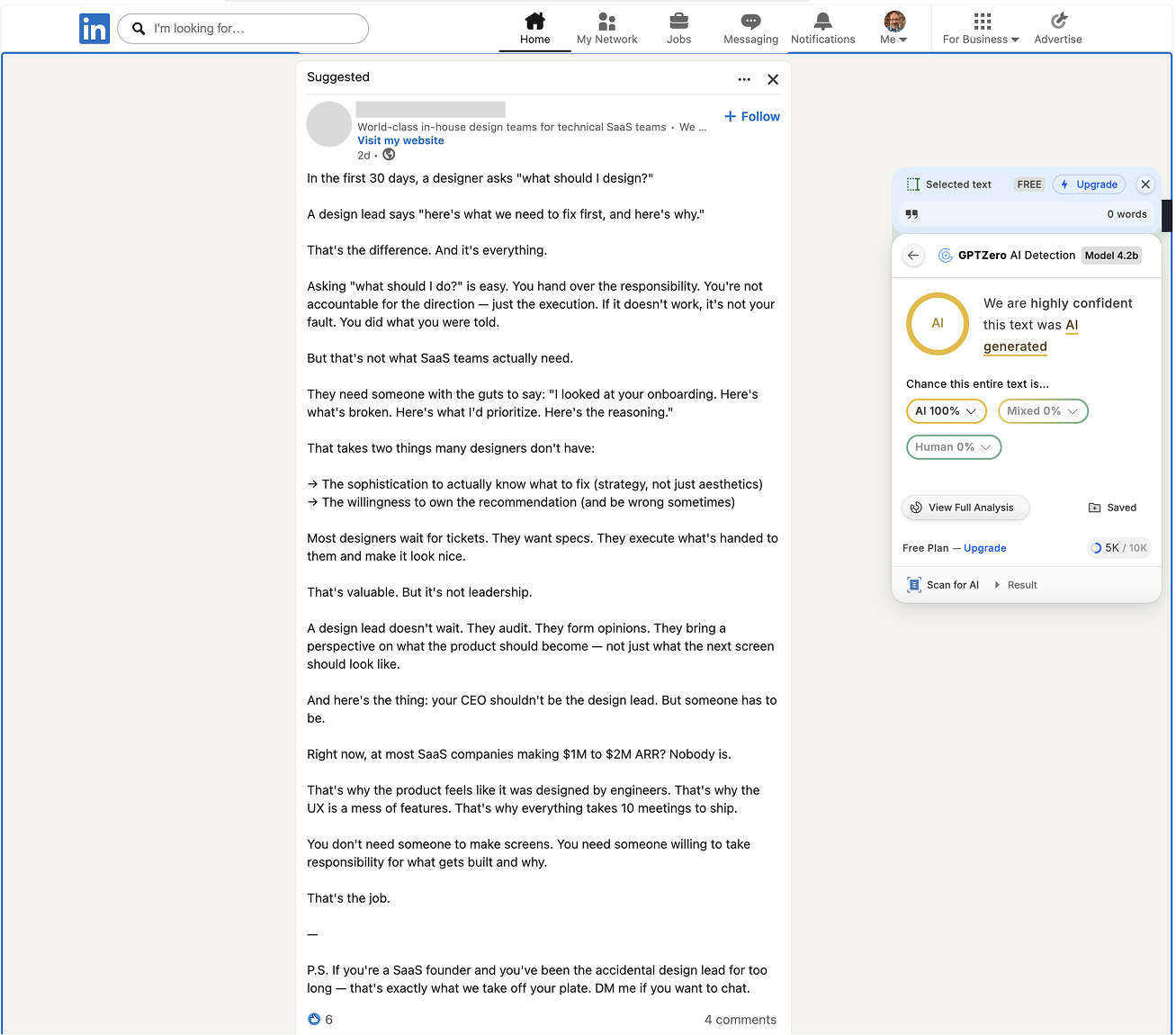
I went to the web app and played around with running my own text through it and it comes back as 100% human. Even more, running text I generated with AI, even though it sounded great, came back as 100% AI. Editing that text came back with mixed percentages.
If you're trying to figure out if a post is AI only because it uses em-dashes that's not going to cut it—believe me, I love em-dashes because they're so typographically interesting.
Authentic writing is a cornerstone of building genuine relationships. So, it's a shame to post something one didn't actually write. You can be sure I'm writing this and all the content at Designy and for The Daily Sprint podcast
Even so, here’s the caution—this is an AI analysis and AI can make mistakes! Even so, it’s fascinating to see there are so many uses of AI embedded in our everyday communication, but it doesn’t need to be.
I’m including a referral link to try GPTZero. I'm happy for you to try it with or without the referral because it can come in handy during everyday browsing.
Oh well, the old product design process doesn’t work now
 Matt Przegietka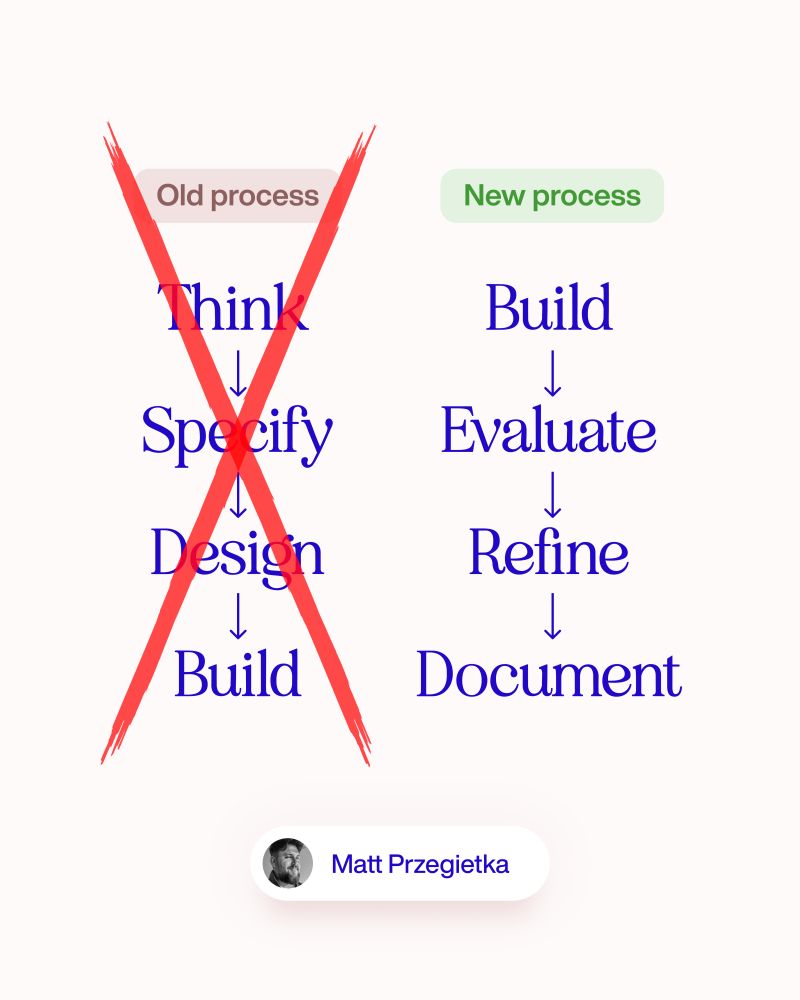
This particular post came out as a mixed AI generated by GTPZero, but I was more interested in the graphic showing the Old process and the New process we’re encouraged to adopt.
I go in depth on this on The Daily Sprint episode 6, Design is Dead Final, Final
Interesting, but this is simply rearranging the deck chairs.
“Thinking,” “Specifying,” and “Designing” are more relevant than ever and will be differentiator skills in the world of AI. Well, they've already been differentiators for decades of product design. Actually, for millennia of human history. It’s how we’re made.
AI is short-circuiting the concept of design if it simply starts with building.
Defining purpose and discovering context is critical if any product will be designed to fulfill an outcome.
You can read more about what I mean by reading Know purpose, know design, and listening to the podcast on Making messy design clear.
Do you say, “I’m sorry” in your design reviews?
 Tyler White
This was 100% written by human Tyler White according to GPTZero. He makes a great point about apologizing for your designs. Although his point is to turn the conversation to making the observer think about consequences of the design.
I have a more collaborative approach.
Tyler is correct—you never should defend your designs. However, you should always explain them. What's the difference?
Defending weakens your position as the lead designer. It's admitting you didn't design it well. That makes the design subjective.
Instead, explaining the design reveals the reason for every design decision you made. That's leadership and that's objective.
The trick, though? You have to have a clear understanding of what the intended outcome was for the feature or app you're designing before you begin. If the outcome was vague and you never clarified it, then those design decisions will come across as a miss.
Even so, there's a clear way to get feedback that's productive and actionable.
Thanks for reading. Have a great day designing with a why.