Designy Digest / 004
The product design AI headlines keep amping up the skill fear, you already have what you need to succeed, and don’t stop learning to hone those design instincts.


Perhaps you’re inundated with genAI design posts like this one. They’re flooding in on all sides. It’s a drumbeat of AI-FOMO—if you’re not using AI to design then you’re missing out or worse outdated.
Keep one eye open, but don’t sweat it. Instead, double down on what’s true.
Skip the design doom and focus on design skills beyond the tool
 Nurkhon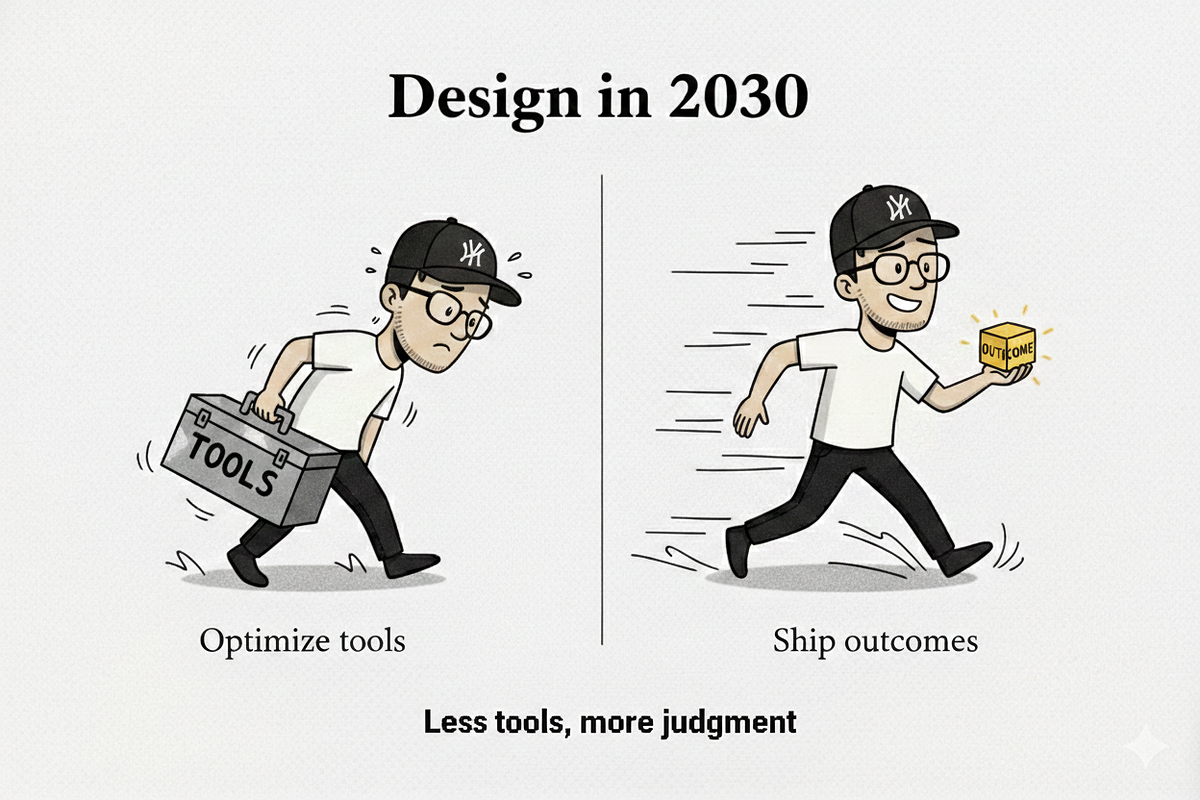
Predictions always make me chuckle. While there is something to be said for cautious curiosity about future trends, declarative headlines like this are click-bait scare tactics. The claim that by 2030 (four years from now) design will all be about shipping outcomes is already outdated.
If you haven’t been shipping outcomes already, four more years won’t move the needle.
Product design has always been about outcomes. The reality is such a small percentage of the effort actually translates into outcomes.
This isn’t because the design process is broken or we never had AI to design for us. It’s a lack of connecting what stakeholders want (i.e. understanding what they really mean, and what users really need) to design decisions (i.e. making deliberate, informed, and outcome-oriented choices). As a designer, you are in the best position to drive these conversations and demonstrate these connections.
AI might make a best guess, but guesswork is not designing. Besides, you can strengthen the skills you already have.
Listen to the top 5 design skills which are essential regardless of technology in Episode 8 of The Daily Sprint podcast.
AI prompting is shortcutting your thinking
 Nick Babich
This is an excellent article for comparing two genAI models and how they generate a dashboard. It’s very thorough, however, the author is splitting hairs.
The real question is in the purpose of prompting a design? Of course, for a demo it’s perfectly fine. I’m more focused on how the pre-design thinking goes away when designers opt to use genAI in their day to day work.
If this were a real-world project, there is no opportunity to explore what it means to create this with “scalability over density” (for example) when we go from 0 to 1 via generative prompting. We might gen and regen dozens of times, but that’s randomization, not design. It’s far more thoughtful to work with the cards in alternate layouts using the principles of visual design and usability.
The output from these models is a predictable presentation of a dashboard as one could find out of the box from some framework. There are so many stronger approaches for presenting the primary purpose of this dashboard: “How much do I have? Where is it going? Am I on track?” In fact, that’s a perfectly reasonable analog prompt for the non-genAI designer, and there’s much more depth that could be discovered through the process of working with the elements by hand (so to speak).
We are missing out on a plethora of possibilities for considering the real challenge: Does the user know where they stand financially within 10 seconds?
It’s fascinating to watch all the buzz and excitement over the AI technology and its output, but it’s not helping us become better thinkers and therefore better designers. At least not yet, but maybe not ever.
Courses that drive you to design for value
I’m on a mission to help product designers be the ones to hone in on the unspoken purpose of a feature and deliberately connect their design decisions to it. Besides that, being able to communicate these decisions to non-designers so they can become design collaborators instead of design blockers.
Take a look at Designy Academy for new courses and vote on ones you’d like to see published sooner than later.
https://academy.designy.com/courses
Thanks for stopping by!